The course · Seeing color · Lesson 2 of 6 · 23 min
Value tells you how light or dark a color is
After this lesson you can look at two colors of one hue and say which is lighter, and by how much. You can also read lightness as a CIELAB L* number from 0 to 100 and sort a gap into low, medium or high.
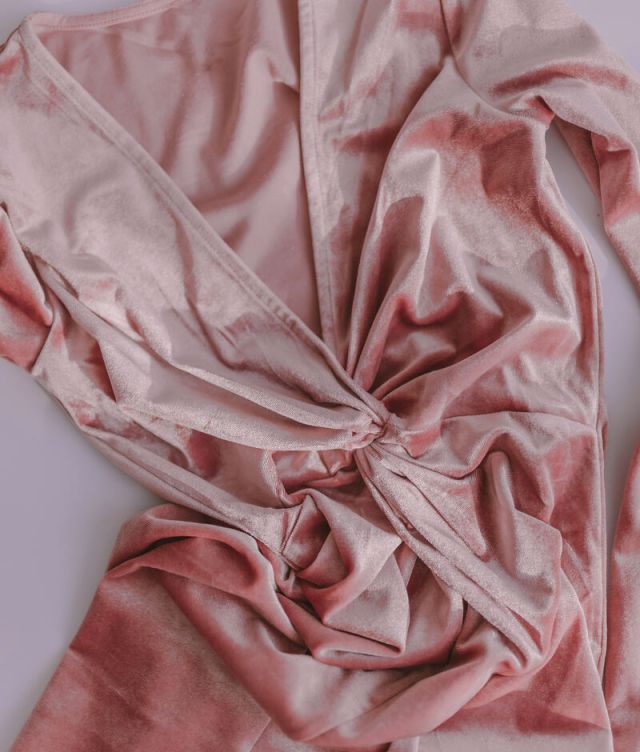
A pale blue sweater and a navy one are the same hue, yet they change a face in different ways.
Hold the pale blue sweater under a client's chin, then the navy one. Both are blue, so the family did not change. One is light and one is dark, and the face reads differently against each. When two colors of one hue look unlike on a client, the difference is how light each is.
Value is how light or dark a color is, from white to black.
Value is the lightness of a color. It is a read on its own, apart from hue and from strength. Munsell defined it as the quality by which a light color is told from a dark one, and his scale runs from 0 for black to 10 for ideal white.
Value is the strongest signal in a drape, so you check it when two colors seem alike.
A drape works against the skin, and the skin has its own lightness. A color that is lighter or darker than the skin changes how the face reads, even when the hue is the same. When a color does not look right on a client, compare its value before you question its hue.
CIELAB writes lightness as L*, from 0 for black to 100 for reference white.
L* is a nonlinear scale, and it is the closest direct number to an analyst's value. Munsell's value runs 0 to 10, and the two scales are not interchangeable, so you never copy a number from one onto the other. A chip at Munsell value 6 is not L* 60.
Color names carry value in their modifiers, and a gap in L* can be sorted into three bands.
ISCC-NBS uses light and dark as modifiers for how far a color sits from a moderate value. The method sorts a gap in L* between an outfit piece and the face the same way. A gap of up to 25 is low, 25 to 45 is medium, and 45 or more is high. These bands are house numbers, not a measured law.
A scarf at L* 85 and one at L* 30 sit at different distances from skin at L* 62.
The first gap is 85 minus 62, which is 23, a low band. The second gap is 62 minus 30, which is 32, a medium band. The lighter scarf is nearer the skin in lightness even though it looks bolder at first glance, and the darker one has the bigger gap.
The method reads depth as skin L* in six steps, and depth says nothing about warm or cool.
The middle lightness of the six steps runs from 74 at step 1, the lightest, down to 34 at step 6, the deepest. Depth is a value read. Whether the skin leans warm or cool is a separate read, taken from its hue.
Figure
One hue and one chroma, stepped from dark to light. Hue 57 and chroma 18 are the typical skin center, and the six lightness values are the middle of each depth step, from step 6 on the left to step 1 on the right.
In their words
“Value is the quality by which we distinguish a light color from a dark one.”
Albert H. Munsell, A Color Notation, fifth edition (1919), paragraph 22
Check
Look at the pale blue sweater and the navy sweater in the first card. What is the one thing that differs between them?
Show the answer
A. Their value, how light each is
Both sweaters are blue, so the hue family is the same. One is light and one is dark, and that difference is value.
Practice
A client's skin reads L* 62. Scarf A is L* 85 and scarf B is L* 30, both in one hue. Which gap is bigger, and which band is it?
Show the answer
B. Scarf B, a gap of 32, medium
Value is the dimension that differs. Scarf A is 85 minus 62, a gap of 23, and scarf B is 62 minus 30, a gap of 32. Only B passes 25, so B is medium. Reading A as 85 uses the scarf's lightness on its own instead of its gap.
A client's cheek reads L* 52. Which depth step is she?
Show the answer
D. Step 4, since 52 is in the 48 to 57 band
Depth is the lightness of the skin, and the bands are 70 and up, 64 to 70, 57 to 64, 48 to 57, 38 to 48 and under 38. L* 52 is inside the fourth band. The step above is 57 to 64, and the step below is 38 to 48.
A client brings a chip written Munsell value 6 and asks you to record it as L* 60. What do you do?
Show the answer
A. Decline, since the two scales are not interchangeable
Value and L* both order light to dark, but their scales and definitions differ, so a number from one is not copied onto the other. The times-ten answer is tempting and is only a rough habit, not a conversion.
A client with skin at L* 66 holds two jackets of one hue, one at L* 70 and one at L* 40. Which statement fits?
Show the answer
C. The L* 70 jacket is a low gap, and the L* 40 one a medium gap
Only the value differs. The first gap is 4, low. The second is 66 minus 40, which is 26, over the 25 line, so medium. Matching hue does not make the gaps equal, because the gap is a lightness difference.
A client at depth step 2 holds a camel coat at L* 62 and a cream coat at L* 90. Skin is L* 67. Which coat is the bigger step from her skin?
Show the answer
D. The cream coat, a gap of 23
Value is the dimension, so compare lightness to skin at 67. The cream coat is 90 minus 67, a gap of 23. The camel coat is 5 away. Reading 62 as the gap confuses the coat's lightness with its distance from the face.
A deep client at depth step 6 asks if her depth means she leans cool. What is the sound reply?
Show the answer
B. No. Depth is a value read; the lean comes from hue
Depth is the skin's lightness, below L* 38 at step 6, and lean is read from a separate number, the hue. Neither reading gives you the other. Both wrong answers read lean from lightness.
Case study 2
A client's skin reads L* 62. She is choosing between a cream blouse at L* 80 and a slate blouse at L* 32, both under the same navy jacket at L* 30.
Work out the gap between each blouse and her skin, sort each gap into a band, and say which blouse is the bigger step.
Show the worked answer
Step 1: the cream blouse is 80 minus 62, a gap of 18, which is low. Step 2: the slate blouse is 62 minus 32, a gap of 30, which is medium. Step 3: the slate blouse is the bigger step, even though cream looks brighter, because the gap is the distance from her skin. Step 4: her skin is depth step 3, and none of this says anything about her lean.