The course · Seeing color · Lesson 3 of 6 · 22 min
Chroma is how vivid or muted a color is
After this lesson you can look at two colors of one hue and one lightness and say which is more vivid. You can also describe a color's strength as a CIELAB chroma number, and lower it without changing the hue.
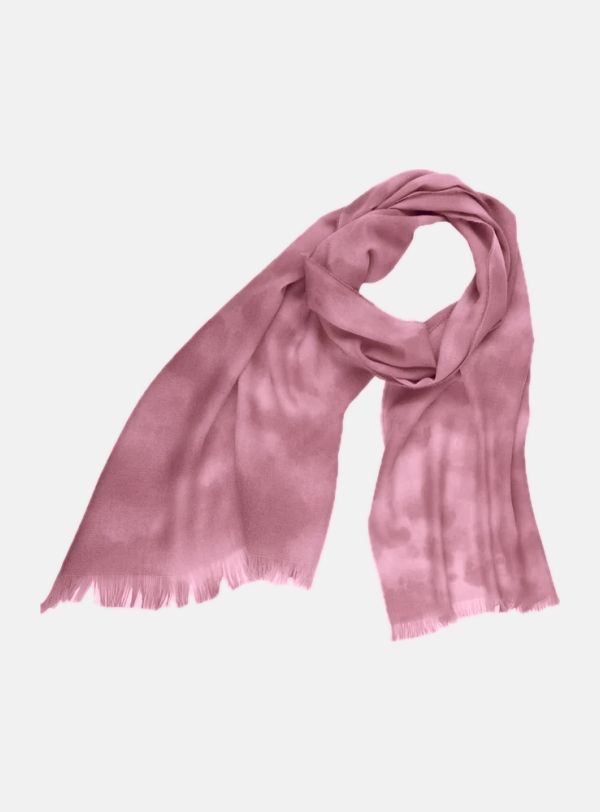
A dusty blue scarf and a cobalt scarf can match in hue and lightness and still look like two different colors.
Lay the dusty blue scarf beside the cobalt one. Both are blue and both sit at the same lightness, so neither is lighter. The dusty one is quiet and close to gray, and the cobalt one is loud. That difference is strength, and it changes how a color sits near a face.
Chroma is how vivid or muted a color is, its distance from gray.
A gray has no chroma at all, and a color with more chroma sits further from gray. Munsell defined it as the quality by which a strong color is told from a weak one. In CIELAB it is the radius out from the neutral center, C* = the square root of a* squared plus b* squared.
Chroma numbers belong to their own scale, so a number never carries over to another one.
Munsell chroma, CIELAB chroma and OKLCH chroma are different scales, and the maximum chroma a color can reach depends on its hue and value. A CIELAB C* of 30 is not a Munsell chroma of 30. Chroma also does not define clarity on its own.
A glossy finish can make a color read as more vivid and darker than the same dye in matte.
A technical overview reports that high-gloss specimens can look more chromatic and darker than similar low-gloss ones. The effect depends on the surface, so no rule says every satin or glossy cloth looks more saturated. Judge strength on the finish the garment will be worn in.
A vivid shade is harder to make, so a bright swatch on a card does not promise the same strength on cloth.
High-chroma shades are sensitive to the dye and the fiber. The same color target may not reach the same depth or fastness on every fabric. A vivid swatch on a card therefore proves little about the cloth, so check strength on the actual fabric.
Take a cobalt at C* 60 down to C* 12 and it keeps its hue and lightness.
A client's cobalt scarf reads L* 45 and C* 60. Step one, hold the hue and the lightness. Step two, lower C* from 60 to 12. The result is a dusty blue, still in the blue family and still at L* 45. Only the strength changed.
The method lowers chroma and keeps hue and lightness when a color is too strong for a face.
The method reads near gray as C* of 4 or less, and the neutral limit as 12. It steps strength at 22 for the soft floor, 35 for the base and 50 for an accent. These marks are house numbers, not a standard, and they apply to the garment, not to a measure of clarity.
Figure
One hue and one lightness, stepped in chroma from gray on the left to vivid on the right. The marks are 0 for gray, 4 for near gray, 12 for the neutral limit, 22 for the soft floor, 35 for the base and 50 for an accent.
In their words
“Chroma is the quality by which we distinguish a strong color from a weak one.”
Albert H. Munsell, A Color Notation, fifth edition (1919), paragraph 23
Check
Look at the dusty blue scarf and the cobalt scarf in the first card. What is the one thing that differs between them?
Show the answer
A. Their chroma, how vivid each is
Both scarves are blue and sit at one lightness, so only the strength differs. The cobalt has more chroma and the dusty blue has less.
Practice
A client's cobalt scarf reads L* 45 and C* 60. Her dusty blue scarf reads L* 45 and C* 12. Which change turned the first into the second?
Show the answer
C. Lower chroma, with hue and L* held
Both scarves sit at L* 45, so lightness did not change, and both are blue, so hue did not change. Chroma fell from 60 to 12. A lower value would change the L*, which stayed at 45.
Two red cardigans share one lightness, L* 60. One reads C* 4 and the other reads C* 50. How do you describe the first?
Show the answer
A. Near gray, since it sits at C* 4 or under
Chroma is the dimension that differs. At C* 4 the cardigan is near gray, and at C* 50 it is accent strength. The soft floor sits at 22, so calling 4 soft or vivid misreads the scale.
A client wears a satin blouse and a matte skirt in one dye. The blouse looks deeper and brighter. What explains it?
Show the answer
D. High gloss can read darker and more chromatic
The dye is the same, so chroma on paper did not differ. High gloss can read darker and more chromatic. It depends on the surface, so matte is not always lower, and the hue did not change.
A buyer says a vivid swatch on a card proves the same strength will show on the cotton. How do you respond?
Show the answer
B. It does not, since dye and fiber change the depth reached
High-chroma shades are sensitive to dye and fiber, so one target may not reach the same strength on every cloth. Dye code and hue do not settle it, so check chroma on the actual fabric.
A client says a Munsell chroma 6 chip should be recorded as C* 6. What is the sound reply?
Show the answer
D. The scales differ, so the number does not carry over
Munsell chroma and CIELAB C* are different scales, and the maximum a color can reach also depends on hue and value. A number is not copied between them, even though both measure distance from gray.
A client's emerald scarf reads C* 55, and it looks too loud near her face. Which change keeps its identity?
Show the answer
A. Lower C*, and keep the hue and the lightness
The scarf is too strong, so chroma is the dimension to lower. Lowering C* keeps the hue and the lightness, so the color stays recognizable. Moving the hue changes the family, and changing L* changes the value.
Case study 3
A client's cobalt scarf reads L* 40 and C* 58, and she says it overpowers her. Her face reads soft, and she likes the hue.
Say what you change and what you keep, and name a target chroma that stays inside the method's marks.
Show the worked answer
Step 1: she likes the hue, so you keep it, and you keep L* 40. Step 2: the scarf is at C* 58, past the accent mark of 50. Step 3: lower C* to the soft floor of 22, or to the neutral limit of 12 for a quieter read. Step 4: check the result on the real fabric, since vivid shades may not reach the same strength on cloth.